Burn by Herman Pontzer PhD
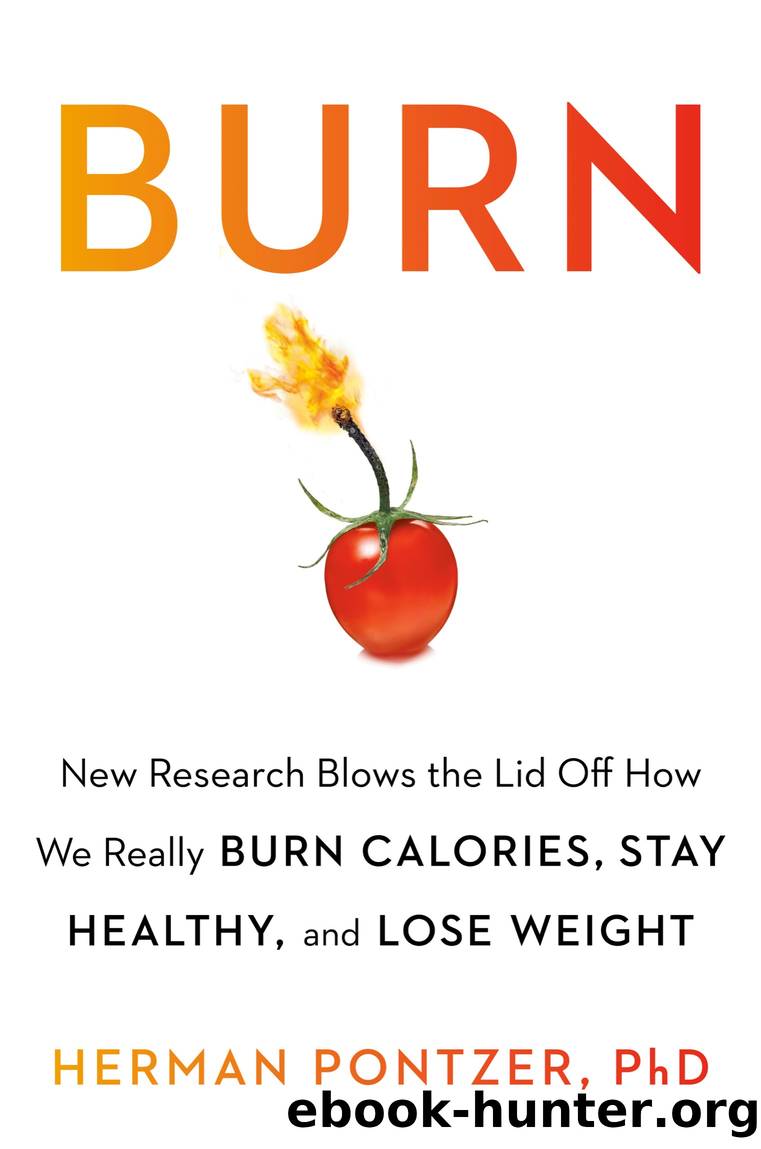
Author:Herman Pontzer PhD [Pontzer, Herman]
Language: eng
Format: epub
Publisher: Penguin Publishing Group
Published: 2021-03-02T00:00:00+00:00
* * *
⢠⢠â¢
The impressive amount of carbohydrate in the Hadza diet and those of other groups is the mirror image of the 30 percent protein, 20 percent carbs, and 50 percent fat energy mix typically promoted as âPaleo.â And some Keto and Paleo proponents have pushed this supposed ancestral mix even further. David Perlmutter, author of the popular book Grain Brain, arguesâwithout providing any evidenceâthat the ancestral diet was only 5 percent carbs and 75 percent fat! Why do so many of todayâs Paleo diet evangelists insist that the ânaturalâ hunter-gatherer diet is low carb and high fat?
Part of the answer lies with Murdockâs Atlas. The modern Paleo diet movement was founded in the late 1990s by Loren Cordain, a professor at Colorado State University who wanted to know why hunter-gatherers were seemingly immune from heart disease and other common Western problems. Cordain was trained as an exercise physiologist, not an anthropologist, so he didnât go to the field to observe hunter-gatherer diets firsthand. Instead, he and his collaborators compiled diet summaries for the hunter-gatherers in Murdockâs Atlas, much as Iâve done in Figure 6.2. They went to great lengths to translate Murdockâs diet scores into precise percentages of fats, carbs, and protein in the diet, and concluded that about 55 percent of calories in the average hunter-gatherer diet came from animal foods. These analyses spawned a number of peer-reviewed scientific papers and formed the basis for Cordainâs influential book, The Paleo Diet, which launched the movement.
These studies were well intended, but they fall short in some key ways. Most fundamentally, the data from Murdock is simply not good enough to get a precise read on dietary intake. His cultural summaries donât say anything about fats, carbs, or protein. Instead, Murdock assigned a dietary score, 0 through 9, to relay a rough estimate of the contribution of different food types to the diet. For the most part, the methods used to determine those scores arenât described. Itâs likely, though, that they missed a lot of carbohydrate-rich foods. As we discussed in Chapter 4, anthropologists in the early and mid-1900s consistently overlooked womenâs contributions, which would tend to underestimate the amount of plant foods. And we know that Murdockâs summaries ignored honey, which is a big part of the diet for the Hadza and many other hunter-gatherers.
Another problem with Cordainâs analyses is the focus on the average proportion of animals and plants rather than on the enormous diversity of diets across the globe. Focusing on the average suggests that thereâs one âtrueâ natural human diet, and anything else leads to disease. That makes as much sense as arguing there is one âtrueâ human height, and anyone who deviates from it is pathological. For some measures, the average value isnât very meaningful. All of the populations in Figure 6.2 are equally natural, and as far as we can tell, all of those populations were equally healthy, despite the fact that their diets ran the gamut from mostly plants to mostly meat.
Download
This site does not store any files on its server. We only index and link to content provided by other sites. Please contact the content providers to delete copyright contents if any and email us, we'll remove relevant links or contents immediately.
The Art of Coaching by Elena Aguilar(53249)
Thinking, Fast and Slow by Kahneman Daniel(12301)
The Art of Thinking Clearly by Rolf Dobelli(10487)
The 5 Love Languages: The Secret to Love That Lasts by Gary Chapman(9809)
Mindhunter: Inside the FBI's Elite Serial Crime Unit by John E. Douglas & Mark Olshaker(9339)
When Breath Becomes Air by Paul Kalanithi(8442)
Periodization Training for Sports by Tudor Bompa(8271)
Becoming Supernatural by Dr. Joe Dispenza(8214)
Turbulence by E. J. Noyes(8047)
Bodyweight Strength Training by Jay Cardiello(7917)
Therapeutic Modalities for Musculoskeletal Injuries, 4E by Craig R. Denegar & Ethan Saliba & Susan Saliba(7722)
Nudge - Improving Decisions about Health, Wealth, and Happiness by Thaler Sunstein(7706)
The Road Less Traveled by M. Scott Peck(7601)
Mastermind: How to Think Like Sherlock Holmes by Maria Konnikova(7342)
Enlightenment Now: The Case for Reason, Science, Humanism, and Progress by Steven Pinker(7311)
Win Bigly by Scott Adams(7194)
Kaplan MCAT General Chemistry Review by Kaplan(6933)
Why We Sleep: Unlocking the Power of Sleep and Dreams by Matthew Walker(6721)
The Way of Zen by Alan W. Watts(6614)
